Tactical Toolkit

Workplace Communication Script Library

Written by Dmytro B., co-founder of DrillUp · Workplace Script Library · Updated

The professional playbook they didn't teach you in school. Clean, assertive, copy-paste templates for any difficult conversation.

Short answer

Use a prepared script when the conversation matters and emotion is likely - asking for a raise, giving hard feedback, pushing back on scope, or correcting credit. Scripts are not about sounding robotic; they are about having already decided your first two sentences before your adrenaline arrives.

boundaries

Declining Late-Friday Request

“Hi [Manager Name], I'd love to help compile this analysis. Currently, my focus is fully committed to delivering [Project A] by our Monday milestone. To preserve the launch quality of both tasks, can we push the delivery of this new report to Tuesday morning, or is there another task we can delegate to make room?”
conflict

Reclaiming Taken Credit in a Meeting

“Thanks for highlighting that concept, [Colleague Name]! Since that is the specific core strategy I compiled and outlined in my weekly status deck, let me expand on the underlying data metrics that led me to that recommendation...”
salary

Negotiating Market Rate Salary

“Over the last year, I've conducted research on local compensation models for my role in [City] at my experience level. The average market rate is [Target Salary]. Given my track record of delivering [Impact Metric], I would love to align my base pay with this standard.”
executive

Minto Pyramid Update to Executives

“Product Launch Update: - Goal Attained: Shipped database rewrite, cutting average user latency by 18%. - Impact: Solves scaling blockers for 50k+ active accounts. - Next Step: Initiating client billing system audit tomorrow.”
boundaries

Countering Micromanager Slack Pings

“Hi [Name]! I'm starting a deep-focus block on [Task Name]. To keep you aligned without cluttering your feed, I will send a consolidated status update by 2:00 PM today. Pinging you then!”
conflict

Dealing with a Criticizing Colleague

“I appreciate you sharing your perspective, [Name]. Let's look at the underlying project parameters together so we can align on a solution that hits our targets without derailing our timeline.”
boundaries

Pushing Back on an Unrealistic Deadline

“We can guarantee a stable Phase 1 by Thursday if we move the analytics dashboard to sprint 12. Which would you rather have first?”
conflict

Disagreeing With Your Tech Lead's Design

“One risk I want on the record: this makes rollback manual, and we deploy on Fridays. Can we add a feature flag, or accept that risk explicitly? Either way, I'll commit to the decision.”
salary

Asking for a Raise at Review Time

“Over the last two quarters I led [project], which [measurable outcome]. I'd like to move my compensation to [target], which is where the market band for this level sits. What would you need to see to support that?”
Ask for a raise →
conflict

A Blocking Comment in Code Review

“Blocking: this loop is O(N^2) and will time out on datasets over 10k rows - a Map lookup fixes it. Optional: extracting this helper would also simplify the test setup.”
leading

Opening Your First 1:1 as a Manager

“This half hour is yours, not a status update. What's one thing that would make your week easier that I could actually change?”
salary

Asking for the Promotion Criteria

“I want to be at senior by the next cycle. What would you need to see from me that you're not seeing now? Can we write that down and check in on it every month?”

Frequently asked questions

Do scripts for difficult conversations actually work?

The opening does. Almost all of the difficulty in a hard conversation is in starting it, and a rehearsed first two sentences carries you past the point where most people either avoid it or blurt something they regret. After that you are simply talking.

What conversations are worth scripting?

Anything where you have a specific outcome and a real chance of emotional derailment: compensation, performance feedback, saying no, correcting attribution, resigning. Routine conversations do not need one.

How do I keep a script from sounding rehearsed?

Memorise the structure and the first line, not the whole thing. Know your opening sentence, your number or ask, and your fallback position, then improvise between them in your own words.

What if the conversation goes off-script?

It will, and that is fine - the script's job is to get you in the room and to hold your position under pressure. Return to your one sentence: the ask, the reason, the number. Everything else can flex.

Practice Live with DrillUp

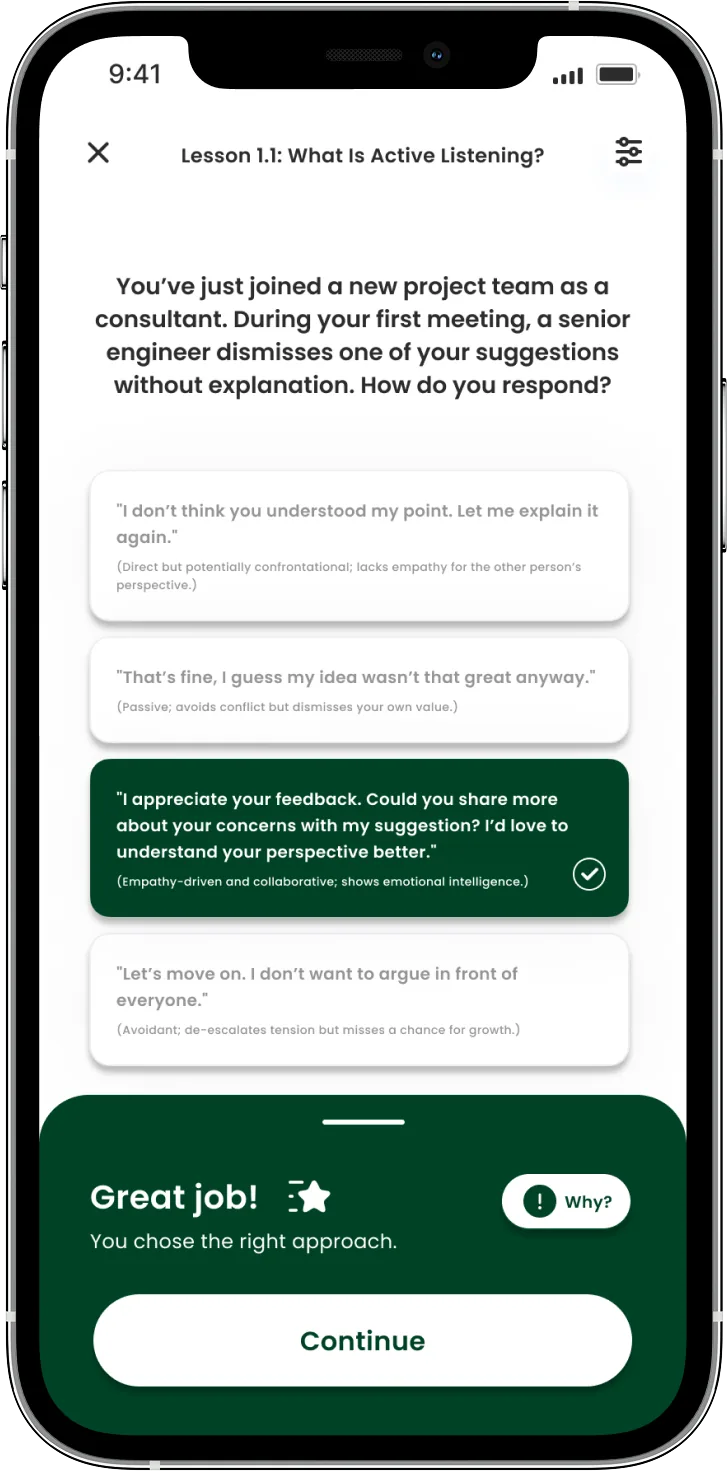
Copying a template is the first step, but delivering it in a high-stakes meeting takes muscle memory. Inside DrillUp, our AI Career Co-pilot simulates micromanagers, tough executives, and salary negotiations in a safe sandbox, giving you real-time feedback on your tone and assertiveness.

Download on the App Store
DrillUp App Simulator Screen